Skip to content

Radiant Heated Floors in Guelph

Radiant Heated Floor Installation in Guelph

A heated floor is the renovation upgrade people are most glad they did. Guelph Flooring Pros installs radiant floor heating in Guelph under tile, stone and engineered hardwood, usually as part of a bathroom, kitchen, basement or entryway flooring project. We are tile and hardwood specialists with more than 15 years of experience, so we install the heating system and the floor on top of it as one job.

That matters because most radiant heating problems happen where the two trades meet. A heating cable nicked by a trowel, a mat laid under a toilet flange or engineered boards heated past their temperature limit are all avoidable when one crew is responsible for both.

This page explains why radiant heat makes so much sense in Guelph homes, the difference between electric mats, loose cable and hydronic systems, which floors can go on top, what the electrical side involves, what it costs to run and what heated floor installation costs. For most homes, it is a small addition to a flooring project that changes how the room feels every winter morning.
  • 15+ years
  • 1500+ jobs
  • WSIB covered
  • 2-year labour warranty
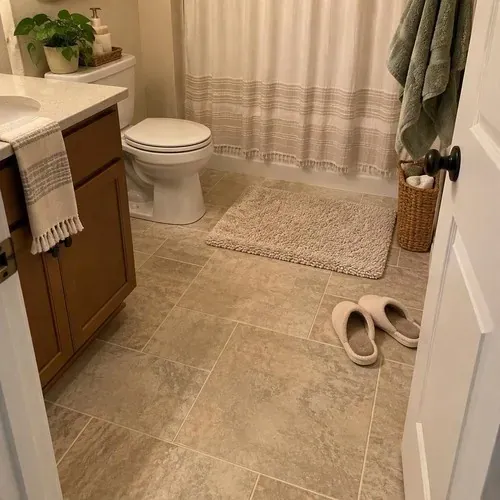
Finished heated tile bathroom floor with bathmat after radiant heated floor installation

1500+

floors completed

Cold Tile Is a Guelph Problem With a Cheap Fix

Guelph winters are long, and tile is cold. It pulls heat from your feet faster than wood or carpet, which is why a porcelain bathroom floor feels icy even when the room is warm.

Basements are worse. Tile or vinyl sitting on a slab in contact with cold ground stays chilly from November to April.

Radiant heat solves that at the source. The floor itself becomes gently warm, typically to around 25 to 29°C at the surface, and the whole room feels more comfortable at a lower thermostat setting.

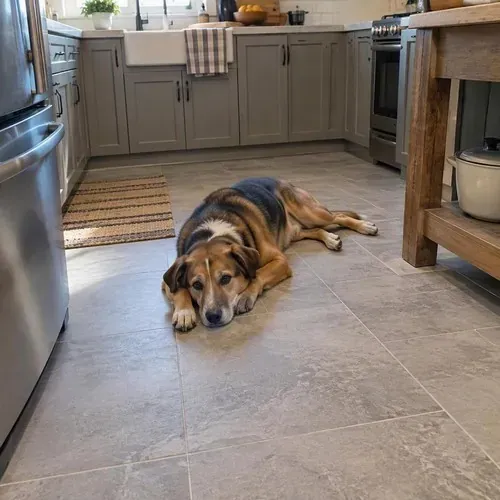
Dog resting on heated porcelain kitchen floor after radiant heated floor installation

The Only Time to Install It Is Now

Radiant heat goes under the floor. Adding it later means removing the tile or wood you just paid for, installing the system and laying new flooring.

When you are already replacing a floor, the extra cost is mainly the heating mat, a thermostat and an electrician's connection. The floor preparation, tile setting and labour are happening anyway.

If there is any chance you will want heated floors in a bathroom, kitchen or basement, decide before the new floor goes down.

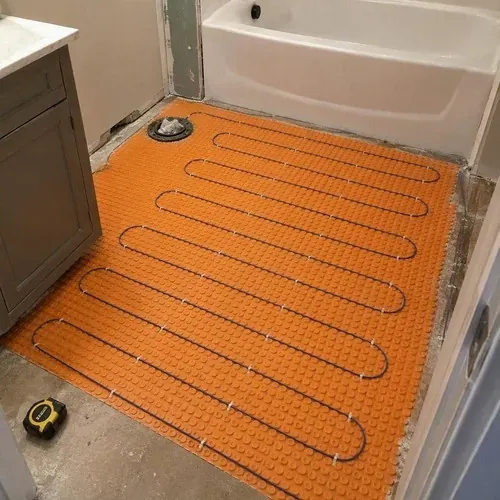
Electric heating cable laid across bathroom membrane during radiant heated floor installation

Electric Mat, Loose Cable or Hydronic

Electric Mats for Bathrooms and Kitchens

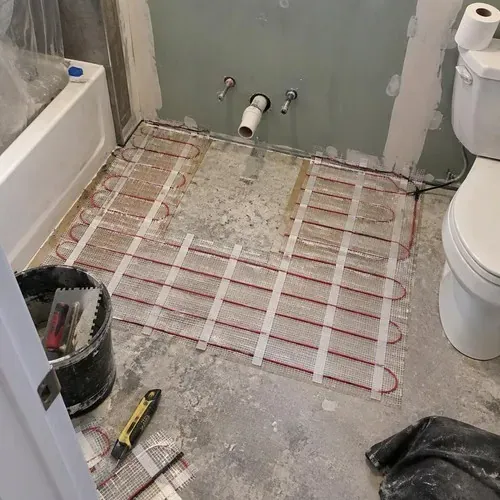
Electric mats are thin heating cables pre-attached to a mesh roll. The roll is laid out over the prepared subfloor and set in thinset or self-leveller directly under the tile.

They are the fastest and most common residential option. Mats come in fixed sizes, so we plan coverage to heat the areas you walk and stand on, not under the vanity, tub or cabinets.

Loose Cable for Awkward Layouts

Loose cable is the same heating element without the mesh backing. It is fixed to strips or laid into an uncoupling membrane designed to hold it, such as Schluter DITRA-HEAT.

It lets us route heat around toilets, curved vanities, angled walls and floor drains where mats won't fit. Combined with an uncoupling membrane, it also protects the tile from subfloor movement.

Where Hydronic Makes Sense

Hydronic systems circulate warm water through PEX tubing embedded in a thin concrete or gypsum layer, or fixed under the subfloor. They are efficient for heating large areas or whole homes and are common in new builds and additions.

Hydronic heat also involves a boiler or water heater, pumps, manifolds and controls, which means a plumbing or HVAC contractor. We install the flooring over hydronic systems and coordinate with your heating contractor, but for most renovations, electric is simpler and more cost-effective.

Which Floors Can Go Over Radiant Heat

Tile and stone

The ideal partners. They conduct heat efficiently, aren't affected by it and hold warmth well. Our tile installation page covers setting tile over heating systems.

Engineered hardwood

Works well within the manufacturer's surface temperature limit, usually about 27°C. The cross-ply core resists the drying that damages solid wood. See engineered hardwood installation.

Vinyl and laminate

Many products are rated for radiant heat with temperature limits. We check the specific product.

Solid hardwood and thick carpet

Generally not recommended. Solid wood dries, shrinks and gaps over heat, and carpet and heavy pad insulate the heat away from the room.

Electrical, Thermostats and Code

The heating system runs on electricity, so the connection has to follow Ontario's electrical rules. In Ontario, electrical work requires an ESA notification and should be done by a Licensed Electrical Contractor.

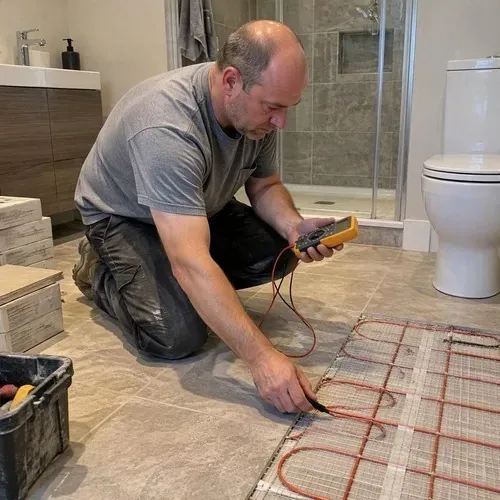
We install the mat or cable and test it. A licensed electrician then connects it to power and installs the thermostat under an ESA permit. We coordinate the electrician for you.

Most floor heating thermostats include built-in ground-fault protection, and a floor sensor limits surface temperature. Larger areas may need a dedicated circuit, which is why we calculate the load before quoting.

Electric heating mat fitted around vanity footprint during radiant heated floor installation

Running Costs, Honestly

A typical electric floor heating system draws about 12 watts per square foot. A 50 square foot bathroom mat uses about 600 watts, roughly the same as a small space heater.

Running it three hours a day uses under 2 kWh, which at typical Ontario electricity rates works out to roughly $8 to $12 a month in winter. A programmable thermostat that runs the floor only in the morning and evening keeps costs down.

Used as supplementary comfort heat in bathrooms, kitchens and basements, it is inexpensive. Used as the main heat source for a whole house, it becomes costly, and we will tell you so.

Electrician testing heating cable with multimeter during radiant heated floor installation

What Heated Floors Cost to Install in Guelph

Typical 2026 prices in Guelph, not including the tile or wood on top:

Item Cost
Electric mat or cable system, installed $14 to $25 per sq ft of heated area
Programmable or Wi-Fi thermostat $200 to $500
Electrician connection and ESA permit $400 to $900

A typical 50 square foot heated bathroom floor adds about $1,300 to $2,600 to a tile project. Hydronic systems are quoted with your heating contractor.

FAQ

Heated Floor Questions

How much does radiant floor heating cost?

Electric radiant floor heating typically costs $14 to $25 per square foot of heated area installed, plus the thermostat and electrical connection. A small bathroom often totals $1,300 to $2,600 on top of the flooring.

Can I put heated floors under hardwood?

Engineered hardwood, yes, within the manufacturer's temperature limit. Solid hardwood is generally not recommended because it dries and gaps. See our hardwood installation and engineered hardwood pages.

Does it need its own thermostat and circuit?

It always needs its own thermostat, which controls the floor independently of your furnace. Small areas can often share an existing circuit if it has capacity, while larger systems need a dedicated circuit.

How long does it take to heat up?

Electric mats under tile usually warm up within 30 to 60 minutes. A programmable thermostat starts heating before you wake up, so the floor is warm when you step onto it.

Free written quote

Add Heated Floors to Your Quote

Planning tile or engineered wood? Ask us to price radiant heat alongside it. Call 226-790-3755 or request a quote.

  1. 1

    Call or send the form

    Tell us the rooms, the floor you want and your timeline.

  2. 2

    Free on-site measure

    We measure, check the subfloor and take moisture readings.

  3. 3

    Itemised written quote

    Every line listed. No deposit needed to receive it.

Open Monday to Saturday 7am to 9pm, Sunday 9am to 5pm.

Call 226-790-3755Free Quote